Wednesday, March 28, 2012

AUDITORIUM MAXIMUM UN MAPA DE TONOS Y SONIDOS


Festival Internacional de Música de Cámara, Medellín Festicámara, bajo la dirección artística del violinista norteamericano Scott Yoo.

ESTE DOMINGO 1 DE ABRIL A LAS 3 DE LA TARDE MEDELLÍN Y EL ÁREA METROPOLITANA VIBRARÁ CON FESTICÁMAR​A DESDE EL AUDITORIUM MAXIMUM

AUDITORIUM MAXIMUM EN ALIANZA CON FESTICÁMARA – FESTIVAL INTERNACIONAL DE MÚSICA CON GRUPOS DE CÁMARA- Y LA RED DE ESCUELAS DE MÚSICA DE MEDELLÍN

Es la oportunidad para reunir, en un mismo escenario, los más destacados intérpretes del mundo con jóvenes de la red de escuelas de música de Medellín

El próximo domingo 1 de abril a las 3.00 de la tarde se presentará en el Auditorium Maximum del Colegio Alemán Deutsche Schule – Medellín la segunda versión de Medellín Festicámara.

Extendemos la invitación a este extraordinario concierto con entrada gratuita.

Las personas interesadas pueden acceder reclamando la boleta, dos horas antes de su inicio, en las instalaciones del Auditorium Maximum ubicado en el campus del Colegio Alemán. Carrera 61 Nro. 34-62 Itagüí, Colombia. Tel. (+574) 2818811 Ext. 235 – 230. auditorium@colegioalemanmedellin.edu.co www.auditoriummaximum.org.co

Medellín Festicámara es un proyecto de la Red de Escuelas de Música de la Alcaldía de Medellín, administrado por la Universidad de Antioquia.

El Auditorium Maximum cuenta con el apoyo decidio de Covitec.

Mayores informes


Friday, March 2, 2012

John Cages's Musicircus May 2006

ORIGINAL: Tate

Musicircus   May 2006
John Cage (with Marina Rosenfeld and La Monte Young), Musical Direction: Richard Bernas

John Cage invented his Musicircus in 1967 for a performance in the Stock Pavilion at the University of Illinois at Urbana-Champaign. This three-hour performance is based on compositions principally by Cage and features live and pre-recorded electronics, as well as traditional instruments. Work by Marina Rosenfeld and La Monte Young were also included in this performance of Musicircus, directed by Richard Bernas, as the original versions of the score also included works by other composers.

From the late 1940s until his death in 1992, John Cage was a central figure in the American avant-garde. He is most commonly known for his silent composition 4'33" of 1952, whose three movements are performed at a piano without a single note being played.

Cage was an early composer of what he called 'chance composition' in music, a method that influenced the radical shift in modern dance initiated by his long-term partner and collaborator, Merce Cunningham, as well as influencing and working with visual artists such as Robert Rauschenberg, Andy Warhol and Jasper Johns. Cage was well known for his non-standard use of musical instruments and his pioneering exploration of electronic music.

Cage invented his Musicircus in 1967 for a performance in the Stock Pavilion at the University of Illinois at Urbana-Champaign. This three-hour performance is based on compositions principally by Cage and features live and pre-recorded electronics, as well as traditional instruments.

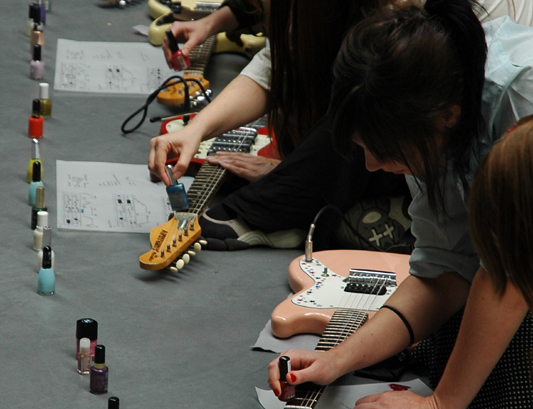
The performers in this version of Musicircus – arranged for Tate Modern by Richard Bernas – range from live electronic composer/performers, including Scanner and Robert Worby, to renowned new-music specialists, among them mezzo soprano Linda Hirst and the Kreutzer String Quartet. Young ensembles from the Guildhall School of Music and Drama and Goldsmiths College, and Marina Rosenfeld – leading her infamous electric-guitar ensemble, the Sheer Frost Orchestra – also perform.

Gramophone Award-winning conductor Richard Bernas collaborated closely with Cage, performing many world and European premieres with him.


Tate Modern; The Long Weekend; 28 May 2006; John Cage, Musicircus. Turbine Hall Bridge, Marina Rosenfeld and the Sheer Frost Orchestra © Tate 2006

DESCRIPTIONS OF ACTIVITIES AND LOCATIONS

TURBINE HALL

1. East end: The Guildhall Percussion Ensemble
John Cage: Atlas Eclipticalis (1961-62)

Counting John Cage: So Percussion pays tribute at UT

ORIGINAL: austin360
By Luke Quinton

Published: Feb. 29, 2012


SPECIAL TO THE AMERICAN-STATESMAN

Of all the bizarre actions we associate with the late composer John Cage the man who made music from burning pinecones and moving water inside conch shells, who turned radio stations into instruments and composed a piece out of silence the thing we forget is that you have to count it out.

"There is that sense of a toy shop or a menagerie," says Adam Sliwinski from So Percussion, the acclaimed Brooklyn group that is about to play two different concerts next week at the University of Texas' McCullough Theatre to honor Cage's centennial.

As percussionists, Sliwinski says, "We don't have 400 years of history. We have 100 years of history."

Cage basically wrote the future of percussion music. "It's like foundation repertoire for what we do."

The percussion "lab" at UT is — as you'd expect — a very loud room. About a dozen players front a comical variety of noisemakers ("manning," because there's just one woman in the group). Gongs, marimba, bass drums, wood blocks, sirens and a piano are waiting for the baton of Thomas Burritt, UT's director of percussion studies.

The members of So Percussion are up front, watching as the students run through a piece from the 1930s by Edgard Varese. The ensemble is in residence, and playing its March dates thanks to the recent grant to UT from the Andrew W. Mellon Foundation. The grant is meant to help launch classical music into the new century, and appropriately, Varese's piece was written to anticipate the coming atomic age.

Sliwinski explains to the class what Varese was about, what's happening behind the beat. Varese, he says, "wanted to make electronic music." At the time, that was just out of reach, so he tried to make a new language of sounds, something entirely alien.

If you think "War of the Worlds," Duchamp, Robert Rauschenberg, you start to size up the creative landscape Cage was working in.

This era exploded with experimental art, and Cage, who greatly admired Varese, dedicated himself to discovering its musical possibilities. To make new sounds, he simply made new instruments.

Cage's materials are always unpredictable: crumpling paper, turntable needles, a hollowed-out tree. Anything, Cage discovered, could become music.

"It wasn't institutionally accepted like it is now," says Sliwinski. A lot of Cage's work was performed far outside the academy — at happenings and art museums.

So Percussion is at the forefront of a wave that Cage began. Champions of new music, including collaborations with pop electronica guru Dan Deacon, Sliwinski says they're taking it in their own direction.

In 1999, the idea of four graduate students emerging from school to found a percussion ensemble seemed unlikely at best.

But it didn't take long for them to gain traction, with concerts, commissions and university residencies very early on, including one at UT in 2002. It was a sign that they could make a living out of being percussionists.

"We came to UT and gave a completely insane concert of all the hardest music we knew how to play," Sliwinski says, smiling.

In those early days they got some of the highest profile commissions imaginable, from Pulitzer Prize winners David Lang of Bang on a Can and Steve Reich.

Now So Percussion is more than a decade in and established as teachers and a touring ensemble.

For their UT concerts, part of a limited spring tour that includes Toronto and Carnegie Hall, So Percussion is playing their favorite Cage music, and the music of his descendants.

At times, says Sliwinski, it's still an effort to explain how important Cage really was (and still is). "It shocks me how contemporary he feels."

Their ambassadorship continues. Online, they have a video of Cage's "Third Construction," a fiendishly complex piece with rotating rhythms that they'll play next week. Somehow they make it look easy, even memorizing their parts. The next video tells us exactly how they became so proficient: They sing it.

"The singing has helped us," Sliwinski says. They can practice without ever unpacking their instruments. Another reminder that percussionists have to be dedicated and brilliant technicians, with impeccable timing in order to pull it off.

After all, those pinecones won't burn themselves.


"We Are All Going In Different Directions: A John Cage Celebration" with So Percussion

When: 8 p.m. Tuesday and Wednesday

Where:McCullough Theatre, UT campus, 2375 Robert Dedman Drive.

Cost:$30
Information: www.texas?performingarts.org

Monday, February 27, 2012

John Cage performs 4:33' (Fragmento)


In this short excerpt from Nam June Paik's "Tribute to John Cage," avant-garde composer Cage is shown performing his famous silent piece "4:33" in Harvard Square, Boston.

Source

Program Tribute to John Cage, A
Copyright Holder Nam June Paik

Description

Program This one-off special by Nam June Paik features the work of the avant-garde composer, John Cage.

In this documentary-style work created by Nam June Paik and narrated by Russell Connor, works by John Cage and Paik are juxtaposed. Cage is shown performing his famous silent piece "4:33" in Harvard Square, Boston, and creating silent pieces for camera in New York City by throwing the I Ching to determine locations for spontaneous performances. One of Paik's robot creations is pictured on the street with bystanders. Composer Alvin Lucier appears in a talk-show-style format to discuss Cage's importance. Directed by David Atwood and Fred Barzyk.

This work was created with financial support from WNET and WGBH. It appears to have been broadcast by both stations.

The "Television Workshop" created several shows that were broadcast on WGBH without being a part of a series sponsored specifically by the Workshop. Additionally, they were commissioned to create shows showcasing video art for national broadcast and created several shows in collaboration with existing series at other stations, such as WNET's "American Playhouse."
Series The New Television Workshop originated at WGBH, a public broadcasting station in Boston, Massachusetts, in 1974 to support the creation and development of experimental video art. This experimental programming included dance, drama, music, performance and visual arts on video and film. As early as 1968, WGBH was committed to the development of video art through residency programs, with artists such as Nam June Paik, and the "Rockefeller Artists-in-Television" project. Many of these early works (pre-1974) were broadcast both locally and nationally.

As an umbrella for arts related programming, the Workshop included "Artist's Showcase, " "Frames of Reference, " "Dance for Camera, " "Poetry Breaks," and "New Television," as well as acquired arts programming. Individual works were created for "Visions," a series produced by WNET (New York), and "Alive From Off Center," a series produced by KTCA (St. Paul - Minneapolis). The Contemporary Art Television (CAT) Fund was co-founded by the Workshop and Boston's Institute for Contemporary Art (ICA) in the 1980's, to commission works by video artists. In 1993 the Workshop ceased production at WGBH.

Variations VII by John Cage (Fragmento)

ORIGINAL:  Metacafe

"Variations VII by John Cage" EXCLUSIVELY DISTRIBUTED by Microcinema DVD. To order this DVD and/or other Microcinema titles, go to: www.microcinemadvd.com.

In 1966 ten New York artists and thirty engineers and scientists from Bell Telephone Laboratories collaborated on a series of innovative dance, music and theater performances, 9 Evenings: Theatre & Engineering, held in October at the 69th Regiment Armory in New York City. The artists were John Cage, Lucinda Childs, Öyvind Fahlström, Alex Hay, Deborah Hay, Steve Paxton, Yvonne Rainer, Robert Rauschenberg, David Tudor and Robert Whitman. Archival material has been assembled into ten films, each of which reconstructs the artist's original work and uses interviews with the artists, engineers and performers to illuminate the artistic, technical and historical aspects of the work.

Variations VII, performed at 9 Evenings, was the next to last in John Cage’s series of indeterminate works that he had begun in 1958, which made increasing use of electronic equipment and systems. This DVD documents the only complete performance of Variations VII and also presents a stereo audio recording of the full 85 minutes of the performance.

This rare and historical film is the second in the 9 Evenings series from E.A.T. and ARTPIX and was produced by Billy Klüver and Julie Martin of E.A.T. and directed by Barbro Schultz Lundestam.


Noise with John Cage

ORIGINAL: fallonmacaodth (Dailymotion)

John Cage in the 1966 documentary "Sound??"


Noise with John Cage por fallonmacaodh

Chance Conversations: An Interview with Merce Cunningham and John Cage


In the spring of 1981, during a residency at the Walker Art Center in Minneapolis, Minnesota, choreographer Merce Cunningham and composer John Cage sat down to discuss their work and artistic process. As frequent collaborators, Cage and Cunningham pioneered a new framework of performance. Their novel approach allowed for mediums to exist independently, or rather cohabitate, within a performance, thus abandoning the co-dependent model of dance and music. Cage and Cunningham go on to discuss the methodology and motivations behind chance operations, a term used to describe artistic decisions based on unpredictability. 

Wanting to free himself of his likes and dislikes, Cage describes how Zen Buddhism influenced his work, leading him to use tools of chance. These new methods, adopted by both Cunningham and Cage, overturned a whole foundation of thought around music, movement, and the process of creating art.