ORIGINAL: John Cage Medellin

Tuesday, July 24, 2012

Tres citas necesarias con Cage. Jueves 26 de Julio
ORIGINAL: JohnCage
JUEVES 26 de Julio
FUNDACIÓN UNIVERSITARIA BELLAS ARTES
CONFERENCIAS:


CONFERENCIAS:
2:00 PM ARTE Y PEDAGOGÍA
4:00 PM DIBUJAR EN EL ESPACIO
Entrada Libre.
No hay límite de cupo.
Los esperamos!
4:00 PM DIBUJAR EN EL ESPACIO
Entrada Libre.
No hay límite de cupo.
Los esperamos!

26-07
6:30PM. CENTRO CULTURAL DE MORAVIA - COMFENALCO ANTIOQUIA
WOLFGANG TIRADO
WOLFGANG TIRADO
Calle 82 No. 52-25 Paseo Urbano Carabobo
Entrada Libre.
No hay límite de cupo.
Los esperamos!

Margaret Leng Tan, Pianista China. 13 de Septiembre 8:00.
HOMENAJE A JOHN CAGE, EL MAESTRO DEL AZAR PLANEADO
LLEGA LA GRAN PIANISTA CHINA MARGARET LENG TAN "LA REINA DEL PIANO DE JUGUETE". POR PRIMERA VEZ EN COLOMBIA
FECHA: 13 DE SEPTIEMBRE
HORA: 8 P.M
LUGAR: AUDITORIUM MAXIMUM
PRECIOS DE BOLETAS:
$50.000 PLATEAS
$30.000 BALCÓN
VENTA DE BOLETAS
EN LOS PUESTOS DE TU BOLETA:
ALMACENES ÉXITO, PRODISCOS - UNICENTRO Y ENTERTAINMENT STORE - EL TESORO
ALMACENES ÉXITO, PRODISCOS - UNICENTRO Y ENTERTAINMENT STORE - EL TESORO
HOMENAJE A JOHN CAGE, MAESTRO DEL AZAR PLANEADO.
UN PROYECTO DE CIUDAD.
UN PROYECTO DE CIUDAD.
GRAN BENEFACTOR: FORMACOL / HUS HOLA / CONTIFLEX
INFORMES: AUDITORIUM MAXIMUM
Colegio Alemán. Deutsche Schule Medellín
Carrera 61 Nro. 34-62
Itagüí, Colombia
Itagüí, Colombia
Tel: 2818811 Ext. 230

Saturday, April 7, 2012
La ciudad se prepara para el Gran Homenaje a John Cage, Maestro del azar planeado. Proyecto liderado por el Centro Cultural AUDITORIUM MAXIMUM.
ORIGINAL: Letras Anónimas - Lucrecia Piedrahíta
abril 4, 2012


Es interés nuestro compartirles el gran proyecto que lidera el Centro Cultural Auditorium Maximum con el apoyo de otras importantes instituciones de la ciudad.
Antioquia y Medellín tienen un nuevo centro para la música, el arte y la ciencia: El Auditorium Maximum es el complejo arquitectónico construido por el Colegio Alemán Deutsche Schule – Medellín como parte de su proyección educativa y cultural. Un centro que comprende una Sala de Conciertos con 602 sillas, una Escuela de Música y un Forum de Exposiciones para el desarrollo de las prácticas artísticas contemporáneas.
Las características estéticas, arquitectónicas y técnicas de nuestro Centro de Cultura son factores diferenciales dentro de la escena cultural, turística y de entretenimiento en Medellín, además su ubicación en un bosque de reserva natural implica sensorialmente al visitante en el escenario más bello recientemente construido en Colombia.
Dentro de la celebración del centenario de nacimiento de John Cage, máxima figura de la Generación Beat, el Auditorium Maximum lidera un gran evento de ciudad al que se unieron otras entidades culturales de la ciudad:
abril 4, 2012
Talleres gratis para todas las personas que iniciarán el sábado 28 de abril a las 10.30 am en el AUDITORIUM MAXIMUM y rotarán en las sedes de las instituciones que apoyan el Homenaje: PARQUE EXPLORA, EAFIT, ITM, MAMM, COMFENALCO… Inscríbete y participa de talleres aplicados, conferencias, conciertos, conversatorios que se tendrán todos los sábados.


Es interés nuestro compartirles el gran proyecto que lidera el Centro Cultural Auditorium Maximum con el apoyo de otras importantes instituciones de la ciudad.
Antioquia y Medellín tienen un nuevo centro para la música, el arte y la ciencia: El Auditorium Maximum es el complejo arquitectónico construido por el Colegio Alemán Deutsche Schule – Medellín como parte de su proyección educativa y cultural. Un centro que comprende una Sala de Conciertos con 602 sillas, una Escuela de Música y un Forum de Exposiciones para el desarrollo de las prácticas artísticas contemporáneas.
Las características estéticas, arquitectónicas y técnicas de nuestro Centro de Cultura son factores diferenciales dentro de la escena cultural, turística y de entretenimiento en Medellín, además su ubicación en un bosque de reserva natural implica sensorialmente al visitante en el escenario más bello recientemente construido en Colombia.
Dentro de la celebración del centenario de nacimiento de John Cage, máxima figura de la Generación Beat, el Auditorium Maximum lidera un gran evento de ciudad al que se unieron otras entidades culturales de la ciudad:
- EPM,
- ITM,
- EAFIT,
- PARQUE EXPLORA,
- MUSEO EL CASTILLO,
- MAMM,
- BELLAS ARTES,
- COMFENALCO,
- CASA TRES PATIOS
entre otras tantas instituciones. Se desarrollará un programa que incluye: conciertos, conferencias, exposiciones de artes visuales, lecturas para difundir el pensamiento filosófico de Cage y acciones performáticas que incluirán teatro y nuevos medios.
John Cage, Maestro del azar planeado tiene como objetivo revisar la obra de Cage desde la interdisciplinariedad del arte, la ciencia y la técnología.
QUIÉN ES JOHN CAGE:
Pionero de la música aleatoria, de la música electrónica y del uso no estándar de instrumentos musicales, Cage fue una de las figuras principales del avant garde de posguerra. Los críticos le han aplaudido como uno de los compositores estadounidenses más influyentes del siglo XX. Fue decisivo en el desarrollo de la danza moderna, principalmente a través de su asociación el coreógrafo Merce Cunningham. ) Si Duchamp se ha revelado como la figura fundamental de principios-mediados del siglo XX, el trabajo de Cage aparece actualmente como un paradigma indispensable de finales del siglo XX y principios del XXI.
“Compongo música con agua de la jarra, una pipa de hierro, una llamada a las gallinas, una botella de vino, un mezclador eléctrico, un silbato, una regadera, cubos de hielo, dos platillos, un pez mecánico, una llamada de codorniz, un pato de goma, una grabadora, un florero, un sifón, cinco radios, una bañera y un gran piano.” J. Cage.
ENCUENTRO ACADÉMICO
Contaremos con:
- Doctor Jorge Wagensberg –físico y director científico de la Caixa Forum de Madrid,
- Anna María Guasch, teórica y crítica de la Universidad de Barcelona,
- Miguel Ángel Hernández. Director del CENDEAC- de Murcia,
- Marcela Quiroz, doctora en Teoría Crítica de México,
- Graciela Speranza, Académica y pedagoga argentina.
- Lucrecia Piedrahita,
- Jaime Cerón,
- Jorge Echavarría,
- Hernán Méndez,
- Pablo Montoya…
ENCUENTRO DE MÚSICAS
CONCIERTOS Y PRÁCTICAS MUSICALES
PRESENCIA DE LA GRAN PIANISTA CHINA, MARGARET LENG
Para el mes de septiembre nos visitará la maestra Margaret Leng, pianista de primer nivel mundial. Con ella se tendrá un gran concierto de gala.
El programa de música cuenta con el apoyo del maestro Andrés Posada- Decano de Música de la Universidad Eafit, así mismo estará la maestra Cecilia Espinosa, el chelista Juan Pablo Valencia y otros grupos de música de las universidades de la ciudad.
EXPOSICIÓN DE ARTE
La curaduría es responsabilidad de Lucrecia Piedrahíta y la muestra se haría en estas fechas: 13 de septiembre a cierre de octubre.
Invitados: Gabriel Botero, Alexandra Mccormik, Leyla Cárdenas, Carlos Bonil, Clemencia Echeverri, Anibal Vallejo, Alejandro Tobón, Adriana Salazar, Angélica María Zorrilla, Edwin Monsalve, César del Valle, Catalina Jaramillo, Nadir Figueroa, Andrés Layos, Pablo Guzmán, Johan Barrios, Mario Vélez, Andrés Layos, Mauricio Carmona, Alejandro García Restrepo, Juan Ricardo Mejía, Johana Bojanini, Marcela Cárdenas, Juan Fernando Ospina, Alejnadro Gracía, Fredy Alzate, Juan Esteban Sandoval, Anna María Botero, Pilar Aparicio, Hugo Cárdenas, Attis, entre otros artistas.
MEMORIAS
Publicaremos el libro impreso de alta factura que además contendrá una multimedia con todo el desarrollo de la exposición de artes visuales, talleres de sensibilización, conciertos, participación ciudadana, videoclips, análisis formal, testimonios…
FECHAS DE CELEBRACIÓN:
Desde el mes de abril comenzaremos talleres de sensibilización en la ciudad y la actividad central del homenaje se tendrá en el mes de septiembre y parte de octubre.
Inscríbete en los mails:
Mayores informes:
AUDITORIUM MAXIMUM
Colegio Alemán / Deutsche Schule Medellín
Carrera 61Nro. 34-62 Itagüí, Colombia
Tel. (+574) 2818811 Ext. 235
Fax: (+574) 3726311
Wednesday, March 28, 2012
AUDITORIUM MAXIMUM UN MAPA DE TONOS Y SONIDOS
ORIGINAL: Letras Anónimas - LUCRECIA PIEDRAHÍTA

Festival Internacional de Música de Cámara, Medellín Festicámara, bajo la dirección artística del violinista norteamericano Scott Yoo.
ESTE DOMINGO 1 DE ABRIL A LAS 3 DE LA TARDE MEDELLÍN Y EL ÁREA METROPOLITANA VIBRARÁ CON FESTICÁMARA DESDE EL AUDITORIUM MAXIMUM
AUDITORIUM MAXIMUM EN ALIANZA CON FESTICÁMARA – FESTIVAL INTERNACIONAL DE MÚSICA CON GRUPOS DE CÁMARA- Y LA RED DE ESCUELAS DE MÚSICA DE MEDELLÍN
Es la oportunidad para reunir, en un mismo escenario, los más destacados intérpretes del mundo con jóvenes de la red de escuelas de música de Medellín
El próximo domingo 1 de abril a las 3.00 de la tarde se presentará en el Auditorium Maximum del Colegio Alemán Deutsche Schule – Medellín la segunda versión de Medellín Festicámara.
Extendemos la invitación a este extraordinario concierto con entrada gratuita.
Las personas interesadas pueden acceder reclamando la boleta, dos horas antes de su inicio, en las instalaciones del Auditorium Maximum ubicado en el campus del Colegio Alemán. Carrera 61 Nro. 34-62 Itagüí, Colombia. Tel. (+574) 2818811 Ext. 235 – 230. auditorium@colegioalemanmedellin.edu.co www.auditoriummaximum.org.co
Medellín Festicámara es un proyecto de la Red de Escuelas de Música de la Alcaldía de Medellín, administrado por la Universidad de Antioquia.
El Auditorium Maximum cuenta con el apoyo decidio de Covitec.
Mayores informes
Friday, March 2, 2012
John Cages's Musicircus May 2006
ORIGINAL: Tate
Musicircus May 2006
John Cage (with Marina Rosenfeld and La Monte Young), Musical Direction: Richard Bernas
John Cage invented his Musicircus in 1967 for a performance in the Stock Pavilion at the University of Illinois at Urbana-Champaign. This three-hour performance is based on compositions principally by Cage and features live and pre-recorded electronics, as well as traditional instruments. Work by Marina Rosenfeld and La Monte Young were also included in this performance of Musicircus, directed by Richard Bernas, as the original versions of the score also included works by other composers.
From the late 1940s until his death in 1992, John Cage was a central figure in the American avant-garde. He is most commonly known for his silent composition 4'33" of 1952, whose three movements are performed at a piano without a single note being played.
Cage was an early composer of what he called 'chance composition' in music, a method that influenced the radical shift in modern dance initiated by his long-term partner and collaborator, Merce Cunningham, as well as influencing and working with visual artists such as Robert Rauschenberg, Andy Warhol and Jasper Johns. Cage was well known for his non-standard use of musical instruments and his pioneering exploration of electronic music.
Cage invented his Musicircus in 1967 for a performance in the Stock Pavilion at the University of Illinois at Urbana-Champaign. This three-hour performance is based on compositions principally by Cage and features live and pre-recorded electronics, as well as traditional instruments.
The performers in this version of Musicircus – arranged for Tate Modern by Richard Bernas – range from live electronic composer/performers, including Scanner and Robert Worby, to renowned new-music specialists, among them mezzo soprano Linda Hirst and the Kreutzer String Quartet. Young ensembles from the Guildhall School of Music and Drama and Goldsmiths College, and Marina Rosenfeld – leading her infamous electric-guitar ensemble, the Sheer Frost Orchestra – also perform.
Gramophone Award-winning conductor Richard Bernas collaborated closely with Cage, performing many world and European premieres with him.
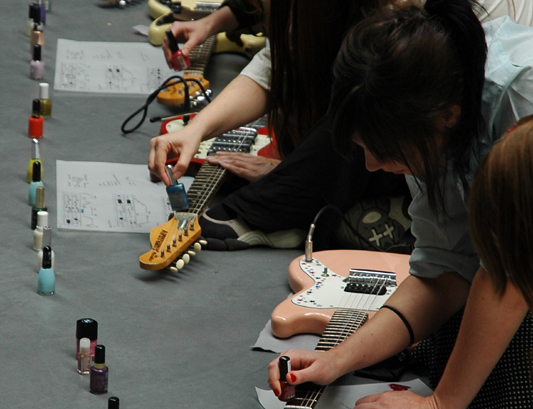 |
| Tate Modern; The Long Weekend; 28 May 2006; John Cage, Musicircus. Turbine Hall Bridge, Marina Rosenfeld and the Sheer Frost Orchestra © Tate 2006 |
DESCRIPTIONS OF ACTIVITIES AND LOCATIONS
TURBINE HALL
1. East end: The Guildhall Percussion Ensemble
John Cage: Atlas Eclipticalis (1961-62)
Counting John Cage: So Percussion pays tribute at UT
ORIGINAL: austin360
By Luke Quinton
Published: Feb. 29, 2012

SPECIAL TO THE AMERICAN-STATESMAN
Of all the bizarre actions we associate with the late composer John Cage the man who made music from burning pinecones and moving water inside conch shells, who turned radio stations into instruments and composed a piece out of silence the thing we forget is that you have to count it out.
"There is that sense of a toy shop or a menagerie," says Adam Sliwinski from So Percussion, the acclaimed Brooklyn group that is about to play two different concerts next week at the University of Texas' McCullough Theatre to honor Cage's centennial.
As percussionists, Sliwinski says, "We don't have 400 years of history. We have 100 years of history."
Cage basically wrote the future of percussion music. "It's like foundation repertoire for what we do."
The percussion "lab" at UT is — as you'd expect — a very loud room. About a dozen players front a comical variety of noisemakers ("manning," because there's just one woman in the group). Gongs, marimba, bass drums, wood blocks, sirens and a piano are waiting for the baton of Thomas Burritt, UT's director of percussion studies.
The members of So Percussion are up front, watching as the students run through a piece from the 1930s by Edgard Varese. The ensemble is in residence, and playing its March dates thanks to the recent grant to UT from the Andrew W. Mellon Foundation. The grant is meant to help launch classical music into the new century, and appropriately, Varese's piece was written to anticipate the coming atomic age.
Sliwinski explains to the class what Varese was about, what's happening behind the beat. Varese, he says, "wanted to make electronic music." At the time, that was just out of reach, so he tried to make a new language of sounds, something entirely alien.
If you think "War of the Worlds," Duchamp, Robert Rauschenberg, you start to size up the creative landscape Cage was working in.
This era exploded with experimental art, and Cage, who greatly admired Varese, dedicated himself to discovering its musical possibilities. To make new sounds, he simply made new instruments.
Cage's materials are always unpredictable: crumpling paper, turntable needles, a hollowed-out tree. Anything, Cage discovered, could become music.
"It wasn't institutionally accepted like it is now," says Sliwinski. A lot of Cage's work was performed far outside the academy — at happenings and art museums.
So Percussion is at the forefront of a wave that Cage began. Champions of new music, including collaborations with pop electronica guru Dan Deacon, Sliwinski says they're taking it in their own direction.
In 1999, the idea of four graduate students emerging from school to found a percussion ensemble seemed unlikely at best.
But it didn't take long for them to gain traction, with concerts, commissions and university residencies very early on, including one at UT in 2002. It was a sign that they could make a living out of being percussionists.
"We came to UT and gave a completely insane concert of all the hardest music we knew how to play," Sliwinski says, smiling.
In those early days they got some of the highest profile commissions imaginable, from Pulitzer Prize winners David Lang of Bang on a Can and Steve Reich.
Now So Percussion is more than a decade in and established as teachers and a touring ensemble.
For their UT concerts, part of a limited spring tour that includes Toronto and Carnegie Hall, So Percussion is playing their favorite Cage music, and the music of his descendants.
At times, says Sliwinski, it's still an effort to explain how important Cage really was (and still is). "It shocks me how contemporary he feels."
Their ambassadorship continues. Online, they have a video of Cage's "Third Construction," a fiendishly complex piece with rotating rhythms that they'll play next week. Somehow they make it look easy, even memorizing their parts. The next video tells us exactly how they became so proficient: They sing it.
"The singing has helped us," Sliwinski says. They can practice without ever unpacking their instruments. Another reminder that percussionists have to be dedicated and brilliant technicians, with impeccable timing in order to pull it off.
After all, those pinecones won't burn themselves.
"We Are All Going In Different Directions: A John Cage Celebration" with So Percussion
When: 8 p.m. Tuesday and Wednesday
Where:McCullough Theatre, UT campus, 2375 Robert Dedman Drive.
Cost:$30
Information: www.texas?performingarts.org
Subscribe to:
Posts (Atom)